Thursday, November 17, 2022

Why my cats are lyonized (and you may be too)

Meet my cats, Echo and Luna:


Figure 1: Meet Luna and Echo


Perhaps not the greatest wild- (or domestic-) life photo ever taken, but it will do for today's purposes, and at least they are both looking at the camera.

You will observe that Luna is a black cat. Echo, on the other hand, seems to be what you would get if you randomly mixed a black and a brown cat together and did not stir very thoroughly.

When we first took them to the vet, she checked Luna first and declared her to be female. She then declared Echo to be female on account of her being a tortoiseshell - or "tortie" - but double-checked to confirm her initial assumption.

So what is going on here?

  1. Why can we be almost certain that a tortie is female?
  2. Why are torties coloured as they are?
  3. And why can we never be one hundred percent certain that a tortie is female?

To answer these questions we need to delve into some cat genetics.

The figure below shows a schematic representation of a cat cell.

Figure 2: Schematic cat karyotype (NB chromosomes do not really have this shape or these colours and they are not all the same size)


The cat-cell nucleus contains thirty-eight chromosomes, but chromosomes usually come in pairs and there are eighteen pairs of chromosomes - thirty-six in all - that are shown in blue and labelled A1, A1; A2, A2 etc. These chromosomes are known as autosomes.

There is also one pair of sex chromosomes shown in yellow. These are the ones we are really interested in here (though the autosomes will get another mention).

Figure 3: Schematic cat cell nucleus showing only the sex chromosomes


One of these is always an X chromosome. If the other is also an X, you end up with a female cat. If the other sex chromosome is a Y, you end up with a male cat.

Echo is female and has two X chromosomes; and the two genes (or, more precisely, the two alleles of the same gene) that make her black and brown lie on her two X chromosomes. They are, in the jargon, X-linked.

Figure 4: Tortoiseshell cat X chromosomes


The point here is that the gene in question cannot occur on the Y chromosome. So an XY, male cat would have one X chromosome with either a black or a brown gene and would thus be either completely black or completely brown.

Of course, male and female cats can be all sorts of other colours and have different sorts of patterning, but that involves various other genes. And "brown" may be more of a cinnamon, orange, or ginger hue. And the colour scheme as a whole can be well defined or muted. Here we are only considering the genes that produce the tortoiseshell appearance, and trying to keep things simple.

Thus we have already answered the first question we posed. If a cat has a tortoiseshell coat, we know that it has two X chromosomes and we can, therefore, be almost certain that it is a female.

##########

But what about our second question. Why the strange random patterning?

In order to appreciate just how strange this is, we might consider what would happen if the black and brown alleles were not X-linked but occurred on one of the autosomal pairs - say the A1 pair.

Figure 5: Hypothetical cat with autosomal genes for black coat colour


If a hypothetical cat had two copies of the gene for black colouring on its A1 chromosomes, it would (unsurprisingly) turn out black (see above).


Figure 6: Hypothetical cat with autosomal genes for brown coat colour


If, on the other hand, a hypothetical cat had two copies of the gene for brown colouring on its A1 chromosomes, it would (unsurprisingly) turn out brown (see above).


Figure 7: Hypothetical cat with autosomal genes for black and brown coat colour


And finally (and less unsurprisingly) if a hypothetical cat had one copy of the gene for black colouring and one copy of the gene for brown colouring on its A1 chromosomes, it would nevertheless turn out completely brown (see above).

I suppose we could, a priori, imagine that such a hypothetical cat might turn out an even shade of very dark brown. Sometime genes can work a bit like that and produce a kind of blend of their effects. But that is not what would happen here. The brown allele of the gene would be dominant over the black allele and the result would be a brown cat.

Back to real cats with X-linked coat colour genes and we get a completely different type of result:

Figure 8: Real cat with X-linked genes for black and brown coat colour


We see random alternating patches of black and brown fur.

The reason for this strange result is something called lyonization. Lyonization is the process whereby one of the two X chromosomes in every cell of a female individual is inactivated (in a randomly chosen fashion) during development of the female embryo. One explanation for lyonization is that it prevents females from making twice as much of whatever the genes on its X-chromosomes are coding for as a male (with only one X chromosome) would make - though, like many things in biology, it is a bit more complicated than that.

Lyonization is named after the British geneticist who discovered it: Mary Lyon. She, like all other females - human or otherwise - also had half her X chromosomes randomly turned off or on, but because humans do not have genes for skin colour on their X-chromosomes, this fact was[i] not so obvious as it is in the case of my feline family member.

We do sometimes see similar things in humans however. The general term for the phenomenon whereby an individual is composed of two or more genetically distinct[ii] cell lines that are descendants of a single fertilized egg is called mosaicism. Random mutations occur every time a cell divides, so, even if we are male and do not have lyonized X-chromosomes, we could all be said to be mosaics. But this term is normally applied where the genetically different cell lines produce significant or visible effects – as they may do (for example) when people end up with different coloured eyes: heterochromia.

When Echo was still a developing embryo, some of the cells in that embryo had just had their black-allele-X-chromosomes turned off and some just had their brown-allele-X-chromosomes turned off and some were waiting to be randomly switched one way or the other. As these cells divided and proliferated, whatever way they were switched was passed down to all their descendants - though all were switched one way or the other before long.

Each of these two cell lines randomly ended up in what became Echo's fur producing cells and she thereby acquired her random patches of black and brown fur.

And this answers the second question posed above. Echo really is rather like a random mixture of two genetically distinct cats.

##########

So how could a tortie possibly (in rare cases) turn out to be male?

Well one possibility is something called Klinefelter's syndrome where males are born with an extra X chromosome. Such individuals are XXY instead of the conventional XY. Because lyonization switches off one X chromosome in each cell, it might be imagined that there are no differences between males with Klinefelter's and males with more conventional karyotypes but, as has been noted, nothing is simple in biology. Klinefelter's tends to cause developmental problems and infertility.

A male cat with Klinefelter's and a gene for black fur on one X chromosome and a gene for brown fur on the other X chromosome will end up with tortoiseshell colouring just like the conventional female tortie. Such a case has been described by a team at the University of Copenhagen [iii].

Another possibility is something called chimerism. Whereas mosaicism occurs when two different cell lines emerge within a single embryo, chimerism occurs when two different embryos merge to form a single embryo. The end result of either mosaicism or chimerism may be a single embryo containing different cell lines but they are very different phenomena.

If we imagine that twin embryos originally destined to become a black tom and a ginger tom merge during embryonic development, the eventual outcome could be a single male kitten with tortoiseshell colouring. I have no idea whether such a cat has ever been discovered and investigated, but it is certainly a possibility.

##########

When I last took Echo and Luna for their jabs in late October, the vet had a young student observing her. "Oh a black cat and an orange and black cat! Just perfect for Halloween!" exclaimed the student.

At Halloween (or Samhain to use its original name) the veil between the surface world and the underworld thins. I hope I have succeeded in thinning the veil between what happens on the surface of a cat and what is going on underneath.


[i] Sadly she died in 2014

[ii] Of course in lyonization, the cells are distinct only in terms of gene expression rather than in terms of underlying genome.

Tuesday, March 3, 2020

All you ever wanted to know about viruses but were afraid to ask


(Well not really all you ever wanted to know, but a few basic facts that will help you make sense of some of what you might hear on your TV and wireless sets during the current coronavirus crisis.)

Complex cells


Let us start with ourselves. We are made of cells. Complex cells[i]. There are a few things to be aware of: Our cells are quite large. You can just about see a human egg cell with your naked eye if you have good eyesight. To see any detail, however, you need to view our cells under a light microscope. This (and some clever preparation and staining) reveals that our cells have outer-membranes (to keep good stuff in and bad stuff out); all sorts of other bits and pieces[ii]; and a nucleus. The nucleus is where our chromosomes live, and chromosomes are basically long strings of DNA[iii].

Simple cells


Most cells in the world are not complex cells, they are simple cells[iv] - such as bacteria. Bacterial cells are generally much smaller than ours; do not have a nucleus and the (usually) single chromosomes (i.e. long strings of DNA) just live directly inside the cell rather than their own little compartment. Like our cells, their cells have outer-membranes, but they also usually have much tougher cell walls around their membranes. As we shall see, these walls are both their Achilles elbow and their Achilles heel.

Figure 1: Some Human cheek cells with accompanying bacteria.[v]


Bacterial infections (and what we can do about them)


The bacteria in the above picture are not inside the cheek cells, they are on the surface of those cells. Cells do not usually get inside other cells and live to tell the tale. It was the two or three times they managed to do this during whole of the evolution that gave rise to complex cells[vi]. Bacteria generally live in and on our bodies in complete harmony with our cells. In fact, our continued well-being depends on their presence. But when “bad” bacteria infect us, they generally do so by getting “inside” our guts or our blood stream or our hair follicles or whatever. This means that you can try to zap them without ripping apart our own cells to get at them. But you still need something that will zap bacterial cells without harming the complex cells (our cells) just next to them.

Fortunately, nature (with a little help from science) has provided a way of doing this in the form of antibiotics. As I have hinted above, there are some key differences between our cells and bacterial cells and antibiotics can exploit those differences to selectively kill bacteria without killing us in the process. One way that antibiotics often work is by attacking the cell walls of bacteria. Since our cells do not have walls, they are normally immune to such assaults.


Antibiotics
Many antibiotics (including, famously, penicillin) come from (or originally came from) other living organisms (fungi or other bacteria) that evolved these substances as chemical weapons to fight other organisms competing for the same territory.

Unfortunately, evolution never stops. The target organisms of specific antibiotics tend to evolve counter measures that render them resistant to those antibiotics and we then have to try and find new antibiotics that will still work. Even more unfortunately, we have been misusing antibiotics on an industrial scale since they were first discovered. By doing things like prescribing antibiotics for viral infections (where they usually have no effect whatsoever – see below) or feeding them in bulk to farm animals in order to increase yields (now banned in Europe), we have reached the stage were many no longer work, and where some bacteria are becoming resistant to all known antibiotics.

Thanks to Brexit, we may soon be “free”, again, to purchase US-reared antibiotic fed meat in our local supermarkets.


So what about viruses?


Viruses – though often described as “micro-organisms” – are not really living things. They do not, for example, feed or excrete anything or grow or respire or react to things you do to them. One key life-like thing they can do is reproduce; but they can only do that by getting inside a cell and hijacking the cell’s internal machinery.

Viruses are basically bits of chromosome. They also have a kind of coat, and often an outer envelope, but all these outer garments are discarded as (or soon after) a virus enters a cell. The viral chromosome then “tells” the cell it has invaded to make squillions of copies of the virus (complete with a new set of outer garments) and then to release those copies by letting the new viruses escape from the cell – a process that typically involves the complete destruction of the host cell.


Viral chromosomes
Imagine if you will a building site where the person in charge keeps certified copies of the architectural drawings and plans safe in his/her briefcase but hands-out photocopies of key pages to the various workers on site so they can follow them in their work. The photocopies get amended, damaged, and re-photocopied but the originals stay safe in the briefcase – taken out only for making more photocopies to hand out.

This is a very rough analogy to what goes on in cells. The master copy (in this analogy) is the DNA chromosome. The slightly dodgy photocopies in the hands of the site workers are RNA copies of the DNA.

While all cells have double stranded DNA chromosomes, some viruses have DNA chromosomes, and some have RNA chromosomes – which may get to work in an infected cell directly (imagine a saboteur posing as a manager and surreptitiously handing out doctored photocopies to the workers in the above analogy) or may first reverse engineer a DNA copy (and slip it in the site manager’s briefcase I suppose).

Viral chromosomes may also be double or single stranded. As the two strands of double stranded D or R NA are complimentary – mirror images if you like – some viruses have to reverse-engineer a “positive” DNA or RNA chromosome strand from their own “negative” single strand before they can get going. (Imagine the site worker handed a photocopy in mirror writing in the above analogy).

Viruses with RNA chromosomes are much less stable than viruses with DNA chromosomes and tend to mutate rapidly.

Their general weirdness makes RNA viruses easier to try and defeat using anti-viral drugs than DNA viruses (see also discussion below) but their propensity to mutate makes them harder to defeat because they present a moving target.

Both HIV and the COVID-19 viruses are single-stranded positive-sense RNA viruses but HIV is also a “retrovirus” (it makes DNA from its RNA). One of the ways in which the successful cocktail of anti-HIV drugs work is by inhibiting this reverse process - our cells don’t normally make DNA from RNA. This line of attack is not available in the case of COVID-19.


Viruses are (typically) very small. Too small to be seen under a light microscope. The average COVID-19 coronavirus is about 100nm in diameter[vii]. For comparison, a typical bacterial cell is about 1000nm across and a human cheek cell about 50 000nm.

Figure 2 Scanning electron microscope image, in false colour, showing the COVID-19 virus (coloured yellow) as it emerges from the surface of a cell (coloured blue and pink).[viii]


Viruses may attack simple (eg bacterial) cells) or complex (eg human) cells – though different types of virus specialize in different types of cell.

Because some types of virus attack bacteria, they can be used as an alternative to antibiotics to treat people (or animals) infected by bacteria[ix]. For various reasons, this use of such viruses has never really taken off as a mass treatment option.

Viruses that infect us – or, more correctly, our cells – are almost always bad news. And eliminating them from our bodies, without thereby also eliminating our bodies, is rather tricky.

As has been noted, bacterial cells that infect our bodies nevertheless live outside our cells, and they have special features that allow us to set about them with chemical weapons that are unlikely to harm our cells. These weapons are almost entirely ineffective against viruses.

One obvious strategy would be to put something inside our cells that destroys bits of chromosome. That would work very against viruses. Unfortunately, this would have the equally obvious side effect of destroying the host cell chromosomes.

In view of these facts, we have to be a bit cleverer and try to design medicines that help stop specific viruses getting into our cells, or getting  out of our cells, or getting in or out of the cell nucleus, or reproducing within our cells. In order to do the last thing, we have to try and be really clever and figure out how a virus is misusing our cellular machinery (to reproduce) in ways that are not part of the normal repertoire of activities for that machinery.

We do have a few anti-viral compounds but, with the obvious exception of treatments for infections with the human immunodeficiency virus (which are now very effective), most anti-viral drugs do not work very well. Sadly, we certainly do not have much today in the way of anti-viral drugs that we can offer to those infected with COVID-19. (See also Viral chromosomes box above.)

What should I do during the current epidemic?

[NB the information below is now out of date and some of it is incorrect]

I do not pretend to be an epidemiologist and I am loath to predict how this might all pan out. My advice is to get up-to-date information from reputable sources like the NHS[x] rather than from the media or stuff you read on the internet.

I shall, however, reiterate the advice that they give:

  •  cover your mouth and nose with a tissue or your sleeve (not your hands) when      you cough or sneeze
  •  put used tissues in the bin immediately
  •  wash your hands with soap and water often – use hand sanitiser gel if soap and water are not available
  •  try to avoid close contact with people who are unwell
  •  do not touch your eyes, nose or mouth if your hands are not clean

The COVID-19 virus’s outer envelope can be defeated by alcohol gels, but thorough washing with soap and water is even better[xi]. Face masks may help you stop touching your own face and might conceivably help catch droplets of snot in the air that contain the virus (especially if worn by the sneezer) but they will not catch tiny airborne viruses and for general wear, they are almost certainly “neither use nor ornament” [but see below] - as they say in these parts.

Stay well!


PS Just to clarify some of the terminology you might hear: The virus itself has been named "SARS-CoV-2"; the illness cause by the virus has been named "COVID-19"; and SARS-CoV-2 belongs to a group of different but related viruses called the "coronaviruses".

PPS Since I wrote this, the evidence in favour of mask-wearing has become much stronger. It is still not as clear cut as many would claim and, as I suggest above, the main benefit would seem to be that mask-wearer protects others rather than him or her self, but I have now taken to wearing a mask when shopping. If I were writing today I wouldn't write that masks are “neither use nor ornament”.


[i] “Eukaryotic” cells in more technical language.
[ii] Such as mitochondria.
[iii] You may remember pictures of chromosomes that show them as fuzzy, roughly X-shaped beasties, but they only look like that – all scrunched up and double – when a cell is getting ready to divide; which is a good time to try an take a picture of them. Most of the time they are too thin to be visible under a light microscope. Confusingly, DNA is, itself, a double stringed molecule.
[iv] “Prokaryotic” cells in the jargon.
[vi] Mitochondria (which help produce energy for our cells), chloroplasts (which make plants green and perform photosynthesis), and quite possibly – though we don’t know for certain - the nucleus of complex cells were all originally simple cells that took up residence inside other cells.
[vii] A Novel Coronavirus from Patients with Pneumonia in China, 2019 https://www.nejm.org/doi/full/10.1056/NEJMoa2001017
[ix] Bacteriophages: potential treatment for bacterial infections. https://www.ncbi.nlm.nih.gov/pubmed/11909002
[x] Overview -Coronavirus (COVID-19) https://www.nhs.uk/conditions/coronavirus-covid-19/

Thursday, January 28, 2016

Nature, Nurture, and the Height of Racism

Or why biological differences between difference "races" are not necessarily anything to do with "race"

This post is not really about human height or race or nature versus nurture (though it concerns all these subjects) it is about the way in which we are so easily led astray when we think about such matters.

People from (say) the UK who go to (say) Japan (I haven’t as it happens) tend to note that the average Japanese person is shorter than the average person back home. This is certainly a recurring theme in the (sometimes borderline racist) film Lost in Translation[1] – though the visitors in that case were, of course, American.

What is the explanation for this difference? It is tempting to jump to the conclusion (as the Daily Telegraph’s questionable Short people have 'shortage' of genes - from where I stole the picture of the three women above - appears to) that it is all down to genes.

I suppose the reasoning goes something like this:

1) British people are taller (on average) than Japanese people (probably true).

2) Height is highly heritable (certainly true).

3) British people have different genes to Japanese people (sort of true).

ergo

The difference in the average height of British people and Japanese people is explained by their differing genetic make-ups (QI-style klaxon should go off).

Counter-intuitively (at least if your intuitions are the same as mine were before I knew anything about genetics) this reasoning is entirely fallacious[2]. NB: This is not to say the conclusion itself is necessarily wrong. I do not actually know how much, if any, of the average difference in height between British people and Japanese people is explained by genes and I am not sure anybody really does for certain. Moreover, I do not think this is a particularly interesting topic. The reason why the reasoning presented above is wrong is, however, rather interesting.

Let us take each of the premises in turn:

1) British people are taller (on average) than Japanese people

According to Society at a Glance 2009: OECD Social Indicators - OECD 2009, the average height of Japanese men was 1.72m (when measured in 2005) and that of UK men 1.77m (when measured in 2006). So there is an average difference, but only one of about 5cm.

2) Height is highly heritable

A few years ago there was a comedy film (which I confess I’ve never actually seen) starring Arnold Schwarzenegger and Danny DeVito masquerading as (presumably) dizygotic (non-identical) twins:

It is well established that tall parents tend to have tall children and small parents tend to have small children. Of course, we can all think of exceptions to this “rule” and if AS and DD really were twins they would constitute such an exception. In real life, we know that AS and DD are not really twins and I rather expect that AS had taller parents and DD had shorter ones. But I think we can safely assume that, even if they had been brought up in the same household and given the same diet and activities throughout life, AS would have still turned out much taller than DD. To put this into scientific terms: the variation[3] in human height across populations really is largely explained by genetics – approximately 80% of the variation according to Scientific American.

3) British people have different genes to Japanese people

What probably strikes most British people first about Japanese people is their epicanthic eye folds – though this trait is by no means exclusively found among Japanese and other East Asian people. The trait is also sometimes encountered in “white” people in places like Poland and Finland and in “black” people and in parts of Africa in places such as Namibia. The trait is nevertheless, even if not a necessary or sufficient condition of “Eastasianess”, clearly genetic. Japanese people (unlike Brits) also tend to be lactose intolerant. This is another clearly genetic trait - albeit a less visible one and one that is also found (somewhat surprisingly) in my very Teutonic looking German nephew and, as it happens, in most of the world’s population[4]. Height in humans is, to the extent it is determined by genes, determined by lots of different genes working together in complicated ways and it is entirely possible that “tallness genes” are less common among Japanese people[5]. But the fact that Japanese people have characteristic features or eschew the consumption of lactose-rich comestibles gives us no particular reason to jump to any conclusions on the presence or absence of other genes in that population[6].

But surely, the man on the Clapham Omnibus insists, consistent differences – with respect to highly heritable characteristics (like height) – between distinct populations must be largely due to nature rather than nurture?

As the song goes, “it ain’t necessarily so” …… and here’s an explanation of why:

Imagine that the aforementioned Arnold Schwarzenegger and Danny DeVito had both really been blessed with twin brothers - monozygotic (identical) twins. Let us call them Colin Schwarzenegger and Basil DeVito. Let us further imagine that the two sets of twins were cruelly separated at birth and each paired off with one of the other set of twins: Arnold and Basil banished at birth to the otherwise uninhabited “Short Island” (an Island where there were very meagre supplies of food); and the (more fortunate) Colin and Danny to “Long Island (where food was plentiful).

On Short Island, A and B both reach adulthood but their growth is stunted:

The luckier C and D on Long Island achieve their full potential (at least from a growth point of view):

(I don’t know how they came by their suits.)

So here we have a case where there is a significant average difference between the (admittedly small) populations of the two islands and where the difference relates to a highly heritable characteristic (to wit height). The variation in height (the difference between A and B on SI and the difference between C and D on LI) is (assuming they shared their rations on SI fairly) entirely due to genetics. Nonetheless, the difference between the two populations, in this thought-experiment, is entirely explained by the differences in the two environments.

This example is, of course, rather contrived. In real life, it is far more difficult to establish whether differences within and between populations have largely (or entirely) genetic or environmental bases. But what this example conclusively demonstrates is that argument presented at the start of this post is a non sequitur. Just because there are significant differences (with respect to highly heritable traits) between nations or races (or any other groups of individuals we care to demarcate) does not entitle us to conclude that those difference are explained by nature rather than nurture.

In other words, the mere fact that differences in height within the UK and within Japan are largely explained by genetics does not - in and of itself - entitle us to conclude that the difference between the UK and Japan explained by genetics. Armed only with that information, we cannot decide whether the difference between the two populations is largely (or entirely) explained by (say) diet rather than by genes. Neither conclusion is ruled out or established by the fact that height is highly heritable.

So next time you hear someone observing that “Jews are clever with money” or “Black people make good runners and have a good sense of rhythm” or “Asian people are highly intelligent” or “Hungarians are good at chess” or whatever, please bear in mind that, even if such claims are statistically true and even if being good at handling money, running, playing the drums, and playing chess are highly heritable, it doesn’t necessarily follow that Jewish, Black, Asian, or Hungarian genes have anything much to do with the observations made.

It should, perhaps, also be added that (let’s play safe here and take the most innocuous example) even if there are genes for being good at chess and these really are more common amongst Hungarians and this “fact” really does explain Hungary’s historical prowess in this field, the implications for social policy are very limited. After all, we know that men are better at running than women and that this fact is explained by biology (men are, after all, taller than women); but if you had a requirement for a fast runner and Paula Radcliffe and I applied for the job, I rather think it would be a mistake to be guided in your choice of candidate by your knowledge of general biology and gender.

In short, neither reason nor science do (or could) lend any support to racism (or sexism).


  1. A film – like the even more questionable Breakfast at Tiffany’s - I confess I rather enjoyed, despite my discomfort at the casual (though unconscious and unintentional) racism.
  2. Of course if the trait were 100% heritable (like blood grouping) such an inference would be valid.
  3. I wrote here about the difference between explaining things like height by genetics and explaining the variation in things like height by genetics.
  4. A story for another day.
  5. The implication of the article I pinched my picture from.
  6. I explore the theme of race and genetic essentialism here.

Thursday, December 3, 2015

Why are there no unicorns …. or are there?

Charles Arthur (@charlesarthur), reacting to a question from a ten year old, posted the following tweet:

Which turns out, like many “silly questions” to be a rather profound one … and one which I certainly struggled to answer (if you have any more answers or object to any of my reasoning or claimed facts, please comment below).

The initial pedantic responses to the question from various geeks like me (and indeed – in one case - from me) pointed out that rhinos don’t have true horns (their “horns” comprise matted hairs) and that they do usually have two horns (one behind the other). But neither of these observations (relevant though they are) do anything to diminish the force of Charles’s question.

As Charles responded to one claim that rhinos don’t have horns: “let’s impale you on one and see how that goes”.

Lots of creatures have horns, antlers, tusks, swords etc, which I shall generalize to: Pointy Things Sticking Out Of Their Heads (PTSOOTHs). Swordfish, walruses, elephants, deer, narwhals, rhinoceroses, and many others spring to mind in this context.

Ptsooths may be composed of bone, cartilage, hair, skin, or tooth enamel. Ptsooths start out, in evolutionary terms, as small bumps that confer some tiny advantage, and evolve from there. They may serve (or have served in different phases of evolution) various purposes which include: protection from predation, hunting weapons, digging tools, and sexual signalling devices.

The term “sexual signalling devices” covers a multitude of sins here. Huge antlers may signal “don’t mess with me” to rival males (and may be used to actually fight rival males) and “please mess with me” to females. In this kind of situation, runaway sexual selection often occurs and – as with the peacock’s tail – we can end up with ptsooths that are far too big for the purpose for which they originally evolved and that may actually be an encumbrance for the ptsoothholder – at least in its non-sexual life.

But to get back to the real topic here, all vertebrates have basic bilateral symmetry[1]. The symmetry is not absolute. Most men have unsymmetrical testicles and while we usually have two lungs and two kidneys, humans only have one spleen, one penis/clitoris, and (timelords aside) one heart. Our single heart does not, however, offend the basic symmetry of the body as much as many imagine:

[2]

The spleen does:

[2]

But these are soft tissues. Vertebrate skeletons are far more symmetrical and (save for the backbone itself and a few other bits) contain two of everything. In particular, the skull (or at least areas of the skull from which ptsooths grow or could grow) develops (embryologically speaking) from two symmetrical sets of bones that fuse together.

[3]

You can see the join!

Jaws (mandibles), foreheads (frontal bones), crowns (parietal bones) are all made from two symmetrical halves with a join (suture) down the middle. Even “single” skull bones – like the occipital bone at the back of the skull – are formed (earlier on in embryo development) from two (or four) initial symmetrically arranged sites.

So to really come to the point (pun intended) animals with ptsooths generally have two or four or six – ie even numbers of ptsooths – because they grow ptsooths from bits of bone that come in pairs and not from the joints between them.

So this could be why there are no unicorns …… but (to go back to Charles’s initial question) what about rhinos? (Let’s just consider the long front horn or consider Asian rhinos which do only have one horn it seems[4]).

Well because the rhino “horn” is essentially a modified tuft of hair, it was free to start evolving wherever on the skull it wished to. After all, many of us have tufts of hair between our eyebrows or on our noses (which many of us pluck out in order not to further enhance our rhino resemblances). Both single or double ptsooths could be useful and the rhino went for a tandem (or single) arrangement because it could[5].

It should be noted that both rhinos and deer still have bilateral symmetry – if Damien Hirst sawed either in half down the middle he’d end up with two pieces that were essentially mirror images of each other. (By the way, I wonder what he did with the other half of his shark?)

”But what about narwhals (the ‘unicorns’ of the sea)?” I hear you all cry.

Well this is where it starts to get really interesting! (So I hope you’ve persevered this far.)

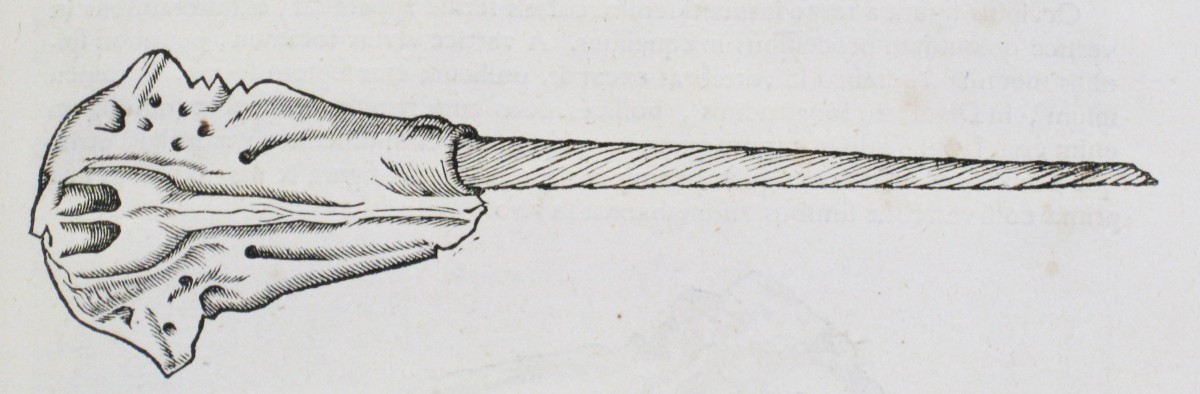
The narwhal[6] “horn” is in fact a tooth – a left canine tooth to be precise. It grows very long and in a helical fashion. The socket for the tusk has migrated very close to the line of symmetry of the narwhal and grows straight forward – providing the unicorn-like appearance:

[7]

– but narwhals are actually slightly asymmetrical:

[8]

Very occasionally, narwhals grow two tusks, but they never grow a single right tusk or reverse the handedness of the helical twist of either tusk.

Unicorns also have a twisted horns and it is often claimed that depictions of unicorn horns were based on observations of narwhal horns.

[9]

Unicorns, however, twist both ways:

[10]

There again, so does DNA – in its depictions! In real life, DNA[11] only goes one way – the opposite way to the narwhal horn.

The ancestors of modern deer also had tusks[12]. Later they evolved horns and their tusks withered away as their horns grew. I see no reason – in principle – why deer or antelope (or other ungulates) could not have evolved to grow (say) only their left horns and why that single horn could not (with a slight asymmetrical deformation in skull development) have moved over towards the centre of the head. Such a “unicorn” would not be quite symmetrical but, given that they have helical horns, unicorns aren’t really symmetrical either.

In fact, thinking about it, I don’t really see why – if the horn were composed of two fused halves (like the swordfish “bill”) – we couldn’t have had a “unicorn” with a single symmetrical untwisted horn.

Moreover, if the frontal and parietal bones of the skull withered away and the occipital bone filled in for them (stranger things have happened in skull evolution) why couldn’t a single horn develop from the middle of that bone in roughly the right place for a unicorn style horn? I know not.

In conclusion then, I have no idea why there are no unicorns …… perhaps there are!


Postscript: Since writing the stuff above, Rab Austen (‏@RabAusten) has reminded me that the triceratops also had a (front) horn on the midline of its skull. This was a "real" (bony) horn and would - as Paolo Viscardi (‏@PaoloViscardi who has forgotten more about bones than I shall ever learn about them) kindly confirmed - have been formed from the fusing of two symmetrical elements - like the swordfish bill. I'm not sure whether a horn formed like this could then grow with a helical twist (though as Paolo also points out, stranger things happen at sea) but Rab's insight certainly lends support to the claim that there is no reason - in principle - why a horse-like creature could not have evolved a bony horn in the middle of its forehead.


  1. Invertebrates often have bilateral symmetry too. Even starfish - which superficially have radial symmetry - have a complicated and interesting way of forming that involves bilateral symmetry. Other invertebrates - snails and sponges spring to mind - break the "rule" in other ways.
  2. http://keckmedicine.adam.com
  3. http://http://fineartamerica.com
  4. Thank you to Steve Jones (‏@TheEulerID) for this information
  5. http://news.bbcimg.co.uk
  6. Please note that evolution does not work in the way I talk about it (metaphorically) in this post. Evolution has no plan, intent, or purpose. It's all natural (or sexual) selection acting on random mutations, It is, however, often easier to describe what happens in evolution using teleological language - as long as we don't forget that it's just a metaphor! OK?
  7. I'm getting all my information about narwhals from Chris McManus's excellent Right Hand, Left Hand which I urge you all to read.
  8. https://cdn-images-1.medium.com
  9. http://www.mermaidsrock.net
  10. http://http://kristell-ink.com
  11. OK I'm talking B-DNA not Z-DNA ... pedant!
  12. Deer Antlers: Regeneration, Function and Evolution by By Richard J. Goss esp p72 et seq