Sunday, October 27, 2013
Why Michael Gove's department is confused about genes and education; and why you probably are too.
In the Guardian on Saturday October 12 it was reported that Michael Gove's special adviser Dominic Cummings had "provoked outrage" by claiming that "up to seventy percent of a child's performance is related to his or her genes".
Now it seems that Mr Cummings has been mis-quoted here. I happen know this because he told me himself in a tweet. His twitter name is @odysseanproject – which I suppose will amuse fans of Diary of a Nobody. Mr Pooter’s favourite joke about his friends Gowing and Cummings was that Gowing was always coming and Cummings was always going.
But I digress.
What the Guardian ought to have said and (it seems) Dominic Cummings did say is that "up to seventy percent of the variation in children's performances is related to their genes".
So why is that different from saying "up to seventy percent of a child's performance is related to his or her genes"? To see why, we need only consider the following simple thought experiment:
Imagine you adopted two randomly chosen children born one the same day (Mary and Jane perhaps) and gave them exactly the same upbringing, environment, life experiences, and education. (Of course that would be impossible in practice, but this is only a thought experiment.) Now imagine that we tested them both (several times perhaps to make sure one of them was not having an off day) at eighteen years old and Mary got straight Bs and Jane got straight Cs.
The variation in the results of the two individuals must, I hope you see, be entirely due to their respective genetic makeups.
Now let us repeat the thought experiment but provide much better education. This time (we could imagine) Mary gets straight As and Jane gets straight Bs. The variation in the results of the two individuals must still be one hundred percent due to their respective genetic makeups. The improvement in results is, however, entirely due to the change in environment - specifically the improvement in education.
This observation illustrates why Dominic Cummings's statement (as mis-reported) is drivel. The seventy percent figure relates to the explanation for the variation in a population not to the performance of an individual.
Asking about the relative contributions of genetics and environment to a particular child’s performance is a bit like asking what whether the height or the length of a rectangle contributes most to its area. Such a question makes no sense.
Asking about the relative contributions of genetics and environment to variation, on the other hand, makes perfect sense.
Some things in a human population may be vary a lot – like personal income. Other things in a human population may vary much less – like height – you do not find people who are two million meters tall for example.
The degree of variation in a population can actually be quantified. (This is quite complicated, and there are different ways of doing it, but let us just stick with the basic idea.) Once we have quantified the amount of variation, we can talk about what factors contribute most to that variation.
If, in the case of school children and academic performance, we took away one of the contributions to variation (which we could do in theory) by breeding a cohort of school kids who were all genetic clones (which would take away the variation due to genetics) or by giving a cohort of school kids exactly the same education (which would take away the variation due to quality of education); in either case, the amount of variation in the population would be reduced. It would obviously be reduced more if you took away whatever was making the biggest contribution.
If we pretend for the moment, and for the sake of simplicity, that education and genes are the only factors (of course there are many others such as social class, but let us keep things simple) what may seem slightly paradoxical is that if we gave all children exactly the same education, though this would reduce the variation in the population, it would increase the relative contribution of genetic factors - it must do so because all variation in a population receiving exactly the same education must be down to the genes.
Of course, as I expect almost everyone agrees (regardless of their politics) the variation in academic achievement (and many other attributes) of the population depends on a complex mixture of factors. Teasing out the relative contributions of the various factors is far more tricky than you might think. Even if we take something like height - which is far easier to measure objectively than academic ability and is undisputedly highly heritable (tall parents tend to have tall kids and vice versa) - it is still far from clear to what extent the variation in human height around the world is down to genes or environment.
I have no idea what the correct figure is for the genetic contribution to the variation in academic achievement in the population at large, but (though I am very much on the political left) it wouldn't surprise me at all to learn that the true figure is even higher than seventy percent.
But, given the fact that nobody knows the facts for sure, people at either end of the political spectrum are wont to provide ideologically-driven rather than data-driven answers to the empirical question: How much is nature and how much is nurture? Hence the irate tone of much of the discussion on this topic in the media this week.
The left's commitment to egalitarian principles lead them to conclude that it must be mostly due to nurture. Only if we believe that, they suppose, can we imagine a future where social inequities are put right through progressive social intervention.
The right's commitment to in-egalitarian principles lead them to conclude that it must be mostly due to nature. Only if we believe that, they suppose, can we justify the claim that doing anything to improve the lot of the hoi polloi is a waste of time.
So why do I claim that both sides get the whole thing rather back to front?
Let us conduct another couple of thought experiments:
First let us first suppose that we have the most extreme case possible of the frequently encountered left-wing belief about the way the world is. Everyone in our imaginary society is a genetic clone with an exactly equal genetic endowment of academic potential and any differences in ultimate achievement will be entirely due to how we nurture the individuals concerned. How would we then structure our education system? We should have to choose individuals completely arbitrarily from the pool and train some of them up to be clever enough to be surgeons or rocket scientists or whatever; and - at the other end - some of them to be just clever enough to tie their own shoe-laces so that they could perform jobs requiring very little intelligence - like the job of Education Secretary I suppose.
But isn't this more or less what right-wing education policy has always been (and what the likes of Michael Gove and Dominic Cummings seem to want to go fully back to): a system where people are picked arbitrarily from the pool on the basis of social class (rather than innate ability) and given the training they require to fulfil their allotted stations in life?
Now, instead of a society of genetic clones, let us imagine a society where everyone is born with different potentials. No matter how well I had been nurtured, I could never have become a Premiere League football player; and the likes of Michael Gove could, no matter how well he had been nurtured, never have understood averages or become a professor of thermodynamics.
...a bit like the world Dominic Cummings and other right-wingers (probably largely correctly) believe we do inhabit.
In this world, it no longer makes sense to choose people arbitrarily from the pool and nurture (only) them. The only policy that makes sense is to nurture everybody so that each person achieves the best he or she is capable of and those who come out on top represent those who started out with the best genes rather than those who were fortunate enough to be given an education.
...rather like the sort of education system left-wingers tend to argue for in fact.
Okay, I've over-simplified here and rather caricatured the various political positions, but I hope I have also successfully made a serious point: the thinking about nature and nurture, on both left and right, is often terribly confused.
A version of this post was included in the @pod_delusion podcast of 2013-10-17.
Thursday, April 25, 2013
DNA double helix: 60 years of sexism in science
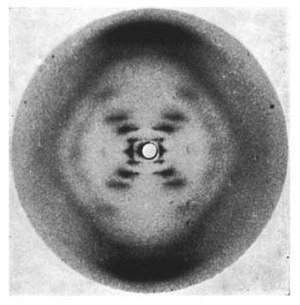
Picture 51
Rosalind Franklin 1920-1958
Sixty years ago today, on 25 April 1953, Francis Crick and James Watson published a paper in Nature describing the double helix structure of DNA.
There have been a flurry of excellent articles in the newspapers to commemorate this auspicious anniversary and, (especially) if you are at all unfamiliar with the history and significance of Crick and Watson's discovery, I wholeheartedly recommend Adam Rutherford's piece in today's Guardian.
Adam also relates some details of Rosalind Franklin's story and the way she was belittled by her male colleagues. Franklin's contribution to the unravelling of the structure of DNA was, to some extent, written out of history - a wrong which has only been righted in relatively recent times - and a number of commentators have sought to rescue her reputation (as they see it), set the record straight, and put Rosalind Franklin's name up there where it belongs alongside Watson's and Crick's. (see for example Anne Sayre and Lynne Osman Elkin)
This is not, however, quite the simple female-goody versus male-baddies tale that some modern accounts suggest. Real stories rarely fit tidy narratives.
Part of the reason Rosalind Franklin was "written out of history" is simply the fact that she died tragically young and Nobel Prizes are never awarded posthumously. Of course whether she would have received the Prize if she had lived is impossible to say, but even Jim Watson is on record as saying that she should have done. The famous Picture 51 (above) which played a crucial role in the DNA story is often credited to Franklin (see eg wikipedia) and is certainly testament to her skills in this field but it was actually taken[1] by her (male) student Raymond Gosling who (as Adam Rutherford also notes) has been written out of history to an even greater degree than his female supervisor. While Jim Watson is astonishingly patronizing in the pages of The Double Helix : A Personal Account of the Discovery of the Structure of DNA, Francis Crick (as is often noted) is far more generous to Franklin and fully acknowledges the significance of her contribution. He does, however, correctly point out that X-ray crystallography alone could never have revealed the detailed chemical structure of DNA and that the Crick/Watson approach to the problem and Franklin's approach were very much complementary strands (if you'll forgive the pun).
As I say, life is complicated.
But regardless of the complex twists and turns (sorry I can't help myself) of history and science, there is no doubt, however, that Rosalind Franklin was the victim of appalling sexism - and not just from Jim Watson.
Inspired by the various newspaper articles I read today, I dug out my copy of What Mad Pursuit (Crick's autobiographical account of the subject at hand) and reminded myself of one or two things he had to say:
Crick goes on to say:
As a younger man, Crick and Watson's work inspired me to go to university and study genetics. It's hard to imagine they inspired many women to do the same. Let us hope that one legacy of the Rosalind Franklin story is that the next sixty years see many more young women entering science and being taken seriously when they do.
[1] The only reason I know this is again down to the aforementioned Adam Rutherford.
Rosalind Franklin 1920-1958
Sixty years ago today, on 25 April 1953, Francis Crick and James Watson published a paper in Nature describing the double helix structure of DNA.
There have been a flurry of excellent articles in the newspapers to commemorate this auspicious anniversary and, (especially) if you are at all unfamiliar with the history and significance of Crick and Watson's discovery, I wholeheartedly recommend Adam Rutherford's piece in today's Guardian.
Adam also relates some details of Rosalind Franklin's story and the way she was belittled by her male colleagues. Franklin's contribution to the unravelling of the structure of DNA was, to some extent, written out of history - a wrong which has only been righted in relatively recent times - and a number of commentators have sought to rescue her reputation (as they see it), set the record straight, and put Rosalind Franklin's name up there where it belongs alongside Watson's and Crick's. (see for example Anne Sayre and Lynne Osman Elkin)
This is not, however, quite the simple female-goody versus male-baddies tale that some modern accounts suggest. Real stories rarely fit tidy narratives.
Part of the reason Rosalind Franklin was "written out of history" is simply the fact that she died tragically young and Nobel Prizes are never awarded posthumously. Of course whether she would have received the Prize if she had lived is impossible to say, but even Jim Watson is on record as saying that she should have done. The famous Picture 51 (above) which played a crucial role in the DNA story is often credited to Franklin (see eg wikipedia) and is certainly testament to her skills in this field but it was actually taken[1] by her (male) student Raymond Gosling who (as Adam Rutherford also notes) has been written out of history to an even greater degree than his female supervisor. While Jim Watson is astonishingly patronizing in the pages of The Double Helix : A Personal Account of the Discovery of the Structure of DNA, Francis Crick (as is often noted) is far more generous to Franklin and fully acknowledges the significance of her contribution. He does, however, correctly point out that X-ray crystallography alone could never have revealed the detailed chemical structure of DNA and that the Crick/Watson approach to the problem and Franklin's approach were very much complementary strands (if you'll forgive the pun).
As I say, life is complicated.
But regardless of the complex twists and turns (sorry I can't help myself) of history and science, there is no doubt, however, that Rosalind Franklin was the victim of appalling sexism - and not just from Jim Watson.
Inspired by the various newspaper articles I read today, I dug out my copy of What Mad Pursuit (Crick's autobiographical account of the subject at hand) and reminded myself of one or two things he had to say:
People have discussed the handicap that Rosalind suffered in being both a scientist and a woman. Undoubtedly there were irritating [sic] restrictions - she was not allowed to have coffee in one of the faculty rooms reserved for men only - but these were mainly trivial, or so it seemed to me at the time. (op cit p 68)Well yes, but though I'm a man, I can kind of imagine that a woman might find something like that a teensy bit more than "trivially irritating".
Crick goes on to say:
Feminists have sometimes tried to make out that Rosalind was an early martyr to their cause, but I do not believe the facts support this interpretation. [...] I don't think Rosalind saw herself as a crusader or a pioneer. I think she just wanted to be treated as a serious scientist. (ibid p 69)Now perhaps I've got the wrong end of the chromosome here, but I always thought that a world where women can be treated as serious scientists is exactly the sort of thing those dreadful feminists have always been arguing for.
As a younger man, Crick and Watson's work inspired me to go to university and study genetics. It's hard to imagine they inspired many women to do the same. Let us hope that one legacy of the Rosalind Franklin story is that the next sixty years see many more young women entering science and being taken seriously when they do.
[1] The only reason I know this is again down to the aforementioned Adam Rutherford.
Monday, August 27, 2012
RNA, the True Secret of Life?
In THE DOUBLE HELIX A Personal Account of the Discovery of the Structure of DNA, James Watson narrates the famous story of Francis Crick bursting into the Eagle Pub to tell everyone within earshot that he had found the secret of life.
Certainly, DNA is one secret of life and (leaving aside a few viruses – which aren’t really alive) is a common (and rather vital) denominator of all terrestrial life. But life has many secrets. Since Crick and Watson (building on the often neglected contributions of Rosalind Franklin) elucidated the structure of DNA, life has revealed more and more of those secrets. But one important secret remains almost as well kept as ever: the secret of just how life emerged in the first place.
There are several rival theories as to how life may have originated on earth (or some other space-rock) but the question of just how we got from a non-living “Primordial Soup” to DNA-based life presents a particular puzzle.
What struck Crick and Watson immediately as they surveyed the model double helix they had constructed were the implications of that structure for DNA replication. Each strand of the DNA double helix comprises a series of nucleotides and (as was later found) these nucleotides constitute the individual “letters” of the DNA code. The two strands of the DNA helix are complementary and the sequence of one strand can be inferred from the sequence of the other. If two strands are separated and furnished with a supply of fresh nucleotides, each strand can serve as the template for the assembly of a new copy of the original double helix.
But if all DNA could do were to serve as a template for making more copies of itself, it would be pretty boring stuff. What makes DNA interesting is that it also serves as a template for making proteins.
It is important to realize here that while proteins are often structural molecules – like muscle proteins – they may also be enzymes – like the enzymes often included in modern detergents. Enzymes are tightly folded proteins that “catalyse” (ie speed-up without getting directly involved themselves) other reactions. Enzymes have specific shapes which allow them to bind to other molecules and thereby encourage those other molecules to react with one another. Enzymes are crucially important for regulating what goes on inside living things.
The way in which proteins (including enzymes) are produced from DNA is quite complex. The first stage involves the creation of multiple RNA copies of the “master” DNA template. RNA is a very similar molecule to DNA – consisting of long chains of nucleotides – but it is normally single-stranded. The second stage involves the creation (from the RNA templates) of long chains of amino acids (which is what proteins are).
But here’s the thing ....
In order to make proteins from DNA, and even to replicate DNA, you need to have proteins (enzymes) that make everything work properly. And where do these enzymes come from? They are coded for by the DNA.
While this system works perfectly well once it is all in place, it is difficult to imagine how the system ever got going in the first place. The solution to this conundrum is that the DNA/protein system is probably not what originally got going. It is almost certainly a refinement of a far simpler system.
It is a feature of the aforementioned single stranded RNA molecule that (as well as serving as a DNA analogue – at least for one strand of DNA) it can also adopt tightly folded configurations which double-stranded DNA could never imitate. This means that, in certain respects, RNA molecules are rather like protein molecules and, it was discovered, can act like primitive enzymes that catalyse other reactions.
Once you have RNA molecules (formed entirely randomly as the primordial soup dribbled down hot rocks) that just happen to be able to catalyse (however poorly) reactions that result in RNA copying, you’re away! The “chicken and egg” problem presented by the DNA/protein system is circumvented. A self-catalysing RNA system will, given a supply of nucleotides, keep on replicating until the cows come home – which, given that replicating systems constantly mutate and the best mutations are chosen by natural selection (and later on in the process by human breeders) is exactly what happened in the end.
Nobody knows for certain how terrestrial life began, but the RNA hypothesis is a strong contender. We may never know exactly what did happen but there is a plethora of exciting research going on with RNA (and similar nucleotide polymers) that is confirming the plausibility of some theories as to what might have happened.
So next time you are enjoying a pint in a university-town, watch out for someone bursting in and announcing that the real secret of life has just been found.
Sunday, April 8, 2012
What is a gene?
Alongside their usual “UNICORNS CAUSE CANCER” style headlines, the tabloid press are also quite fond of “BOFFINS DISCOVER THE GENE FOR BELIEVING IN UNICORNS” style headlines. I think it kind of goes without saying that most of those who write such headlines have only the vaguest idea of what a gene is. To be fair, the more we discover, the vaguer the scientific notion of what a gene is has become, but the basics are very well established.
So what is a gene?
There are all sorts of useful analogies, similes, and metaphors we can use here. I think my favourite is the story of the pilgrim who asked for an audience with the Dalai Lama.
Now we’ve all heard of the “chromosome”. Say this word to most people (and indeed Google images) and it probably conjures up an image like this:
Now there’s a good reason why the word “chromosome” conjures up an image like this. Basically, it’s when chromosomes look like this that we can see them under normal microscopes. But chromosomes only look like this (all bunched up and double) when they are getting ready to divide. Most of the time, and in most organisms, chromosomes look nothing like this.
Most people (even journalists) who’ve heard of chromosomes have also heard of “DNA” and are aware that it comes in the form of a double helix:
This is basically what you are looking at (ignoring all sorts of caveats that we can sweep under the lab bench for now) when you look at a length of chromosome (or at one of the strands of the chromosome in the doubled up chromosome in the chromosome picture).
So there you have it, chromosomes are (caveats aside) basically long strands of DNA.
But we haven’t mentioned “genes” yet I hear you cry.
Well a gene is a short(ish) bit of chromosome (or DNA strand if you prefer). Now (returning to analogies) “genes” are often compared here to beads on a string. But, since there isn’t really any “string” (just molecules and links between them) popper beads maybe provide a better analogy …. except that there aren’t really any beads either.
Let’s look at the DNA molecule in more detail:
DNA is made from Nucleotides – which is what the “N” stands for in “DNA”. There are just four different nucleotides involved Adenine, Cytosine, Guanine, and Thymine - which are often denoted by their initial letters: A, C, G and T.
If we un-twist the DNA and look at a short bit of it, it looks a bit like this:
But that’s already a bit complicated, so let’s simplify things still further:
(For any pedants reading, each box here represents a nucleotide together with a phosphate deoxyribose; but let's keep things simple.)
Now the more astute among you will have noticed that these two strands are complementary – the sequence of Gs, Cs,As and Ts in the strand at the bottom can be inferred from the sequence of Gs, Cs,As and Ts in the strand at the top (and vice versa).
As this implies, we only really need one strand and, indeed, we are only really interested in one stand today: the” sense” strand. The complementary strand is “anti-sense” and we can ignore it until we come to DNA duplication – which we’re not going to come to in this post.
These are a bit like popper beads I suppose, but they are nucleotides not genes. There may be, not billions and billions and squillions (said in a Lancashire accent), but certainly hundreds or thousands of these in one gene.
So what use is that?
Well these for nucleotides form a kind of code – a code comprising only four “letters”, but a very powerful code for all that.
But if a chromosome is just a long series of nucleotides and a gene is a simply a part of that series, how do we know where one gene ends and the next one begins?
Well I suppose (and here I’m going to resort to a serious(ish) analogy) it’s a bit like the old style telegrams where you were restricted to twenty-six capital letters and that was it. You had to write stuff like ….
It’s like that with the genetic code. There’s no punctuation, it’s all in the sequence of “letters”, but, as has been noted, we don’t even have twenty-six, we only have four. These make up three letter “words” called “DNA triplets” and each triplet codes for one amino acid.
Just as a DNA strand is a string of nucleotides, a protein is a sequence of amino acids and each gene coded for the string of amino acids that make up a particular protein. Like this:
So the sequence of nucleotides CTA codes for the amino acid “aspartic acid”, AAA codes for the amino acid “phenylalanine” and ATG codes for “stop making protein”.
Since this “protein” only has two amino acids in it, I’m not sure you can really call it a “protein”. It would more usually be called a “dipeptide”. But you’ve almost certainly eaten some of this (give or take a methyl group); it is the artificial sweetener called “aspartame” or “Nutrasweet”. I doubt that there are actually any real genes out in the wild for making aspartame, but I suppose there could be, and it’s a nice simple example of what a very short gene could do.
So now you understand what a gene is. It’s a sequence of nucleotides that codes for a protein (or at least part of a protein – some proteins are made from more than one amino acid chain).
I suppose, armed only with the understanding presented above, you could (naively) begin to imagine that if you have lots of genes for (say) muscle protein (or genes that produce extra good quality muscle protein) you might be more likely to make it as athlete, but how does it all get so complicated and how can you have a gene for believing in unicorns?
Well part of the answer (the full answers really are complicated) is that proteins, as well as being structural like muscle proteins, can be regulatory, like enzymes – which control all sorts of things that go on in our bodies.
Once you consider that the products of some genes can control what other genes do (in all sorts of complicated direct and indirect ways that we don’t need to go into here) you begin to realize that genetics is very sophisticated and subtle and complex.
Your computer is not really built from the kind of transistors you used to get in transistor radios any more (and still less from valves) but the principle is the same. A transistor is a switch that turns another switch on and off. Once you start putting a few transistors together, you rapidly start to get quite complex behaviour. Put shedloads together and you get something that can do stuff like decide to stall my Ford Galaxy just before I want to set off from a junction (while producing a fault-code which my garage insists doesn’t exist).
Anyway I digress. My point is that even simple feedback mechanisms (and the feedback mechanisms in genetics are far from simple) can produce really really complex behaviour.
Some species of bird are genetically programmed to build very sophisticated nests to lie in. My cats are genetically programmed to catch birds (fortunately for the birds they’re both rather crap at it) but are not genetically programmed (and not bright enough) to even move a twig out of the way before lying down on an otherwise perfectly comfortable and sunny patch of grass in the garden.
These complex behaviours require lots of genes (and maybe lots of so called “junk” DNA) working in harmony. On the other hand, the colours of my cats (one is black and the other is tortoiseshell) arise from the actions of just one or two genes (though even here – especially in the case of the tortoiseshell – things are a bit more complicated than you might imagine).
So while you probably can’t really have a gene for believing in unicorns, you probably can (for example) have a genetic makeup that makes you more susceptible to superstition and irrational views.
At heart, however, a gene is simply a code for making a protein.
So what is a gene?
There are all sorts of useful analogies, similes, and metaphors we can use here. I think my favourite is the story of the pilgrim who asked for an audience with the Dalai Lama.
He was told he must first spend five years in contemplation. After the five years, he was ushered into the Dalai Lama's presence, who said, 'Well, my son, what do you wish to know?' So the pilgrim said, 'I wish to know the meaning of life, father.' And the Dalai Lama smiled and said, 'Well my son, life is like a beanstalk, isn't it?' “In Held 'twas In I” by Procol HarumBut I’m going to try here to describe what a gene (the real secret of life) really is instead of what it is a bit like.
Now we’ve all heard of the “chromosome”. Say this word to most people (and indeed Google images) and it probably conjures up an image like this:
Now there’s a good reason why the word “chromosome” conjures up an image like this. Basically, it’s when chromosomes look like this that we can see them under normal microscopes. But chromosomes only look like this (all bunched up and double) when they are getting ready to divide. Most of the time, and in most organisms, chromosomes look nothing like this.
Most people (even journalists) who’ve heard of chromosomes have also heard of “DNA” and are aware that it comes in the form of a double helix:
This is basically what you are looking at (ignoring all sorts of caveats that we can sweep under the lab bench for now) when you look at a length of chromosome (or at one of the strands of the chromosome in the doubled up chromosome in the chromosome picture).
So there you have it, chromosomes are (caveats aside) basically long strands of DNA.
But we haven’t mentioned “genes” yet I hear you cry.
Well a gene is a short(ish) bit of chromosome (or DNA strand if you prefer). Now (returning to analogies) “genes” are often compared here to beads on a string. But, since there isn’t really any “string” (just molecules and links between them) popper beads maybe provide a better analogy …. except that there aren’t really any beads either.
Let’s look at the DNA molecule in more detail:
DNA is made from Nucleotides – which is what the “N” stands for in “DNA”. There are just four different nucleotides involved Adenine, Cytosine, Guanine, and Thymine - which are often denoted by their initial letters: A, C, G and T.
If we un-twist the DNA and look at a short bit of it, it looks a bit like this:
But that’s already a bit complicated, so let’s simplify things still further:
(For any pedants reading, each box here represents a nucleotide together with a phosphate deoxyribose; but let's keep things simple.)
Now the more astute among you will have noticed that these two strands are complementary – the sequence of Gs, Cs,As and Ts in the strand at the bottom can be inferred from the sequence of Gs, Cs,As and Ts in the strand at the top (and vice versa).
As this implies, we only really need one strand and, indeed, we are only really interested in one stand today: the” sense” strand. The complementary strand is “anti-sense” and we can ignore it until we come to DNA duplication – which we’re not going to come to in this post.
Going back to analogies again for a second, it’s a bit like every time Guardian journalist Ben Goldacre (@BenGoldacre / http://www.badscience.net) writes a sensible sentence in his blog, Daily Mail journalist Melanie Phillips (@MelanieLatest / http://melaniephillips.com) writes a completely irrational and nonsensical sentence in her blog, and the two kind of cancel each other out.Anyway, this leaves us with:
These are a bit like popper beads I suppose, but they are nucleotides not genes. There may be, not billions and billions and squillions (said in a Lancashire accent), but certainly hundreds or thousands of these in one gene.
So what use is that?
Well these for nucleotides form a kind of code – a code comprising only four “letters”, but a very powerful code for all that.
But if a chromosome is just a long series of nucleotides and a gene is a simply a part of that series, how do we know where one gene ends and the next one begins?
Well I suppose (and here I’m going to resort to a serious(ish) analogy) it’s a bit like the old style telegrams where you were restricted to twenty-six capital letters and that was it. You had to write stuff like ….
LEAVE THE CAR STOP JACK WILL PICK YOU UP FROM THE STATION STOP BILL WILL BE THERE TOO STOP LATE ON FRIDAY NIGHT WELL MAKE OUR WAY UP TO KATES STOP BUM A LIFT IN THE MORNING TO CHARLIES STOP AUNT DORIS WILL ALSO STOP STOP…. in order to avoid misreading (try it without the STOPs).
It’s like that with the genetic code. There’s no punctuation, it’s all in the sequence of “letters”, but, as has been noted, we don’t even have twenty-six, we only have four. These make up three letter “words” called “DNA triplets” and each triplet codes for one amino acid.
Just as a DNA strand is a string of nucleotides, a protein is a sequence of amino acids and each gene coded for the string of amino acids that make up a particular protein. Like this:
So the sequence of nucleotides CTA codes for the amino acid “aspartic acid”, AAA codes for the amino acid “phenylalanine” and ATG codes for “stop making protein”.
Since this “protein” only has two amino acids in it, I’m not sure you can really call it a “protein”. It would more usually be called a “dipeptide”. But you’ve almost certainly eaten some of this (give or take a methyl group); it is the artificial sweetener called “aspartame” or “Nutrasweet”. I doubt that there are actually any real genes out in the wild for making aspartame, but I suppose there could be, and it’s a nice simple example of what a very short gene could do.
Conclusion
So now you understand what a gene is. It’s a sequence of nucleotides that codes for a protein (or at least part of a protein – some proteins are made from more than one amino acid chain).
I suppose, armed only with the understanding presented above, you could (naively) begin to imagine that if you have lots of genes for (say) muscle protein (or genes that produce extra good quality muscle protein) you might be more likely to make it as athlete, but how does it all get so complicated and how can you have a gene for believing in unicorns?
Well part of the answer (the full answers really are complicated) is that proteins, as well as being structural like muscle proteins, can be regulatory, like enzymes – which control all sorts of things that go on in our bodies.
Once you consider that the products of some genes can control what other genes do (in all sorts of complicated direct and indirect ways that we don’t need to go into here) you begin to realize that genetics is very sophisticated and subtle and complex.
Your computer is not really built from the kind of transistors you used to get in transistor radios any more (and still less from valves) but the principle is the same. A transistor is a switch that turns another switch on and off. Once you start putting a few transistors together, you rapidly start to get quite complex behaviour. Put shedloads together and you get something that can do stuff like decide to stall my Ford Galaxy just before I want to set off from a junction (while producing a fault-code which my garage insists doesn’t exist).
Anyway I digress. My point is that even simple feedback mechanisms (and the feedback mechanisms in genetics are far from simple) can produce really really complex behaviour.
Some species of bird are genetically programmed to build very sophisticated nests to lie in. My cats are genetically programmed to catch birds (fortunately for the birds they’re both rather crap at it) but are not genetically programmed (and not bright enough) to even move a twig out of the way before lying down on an otherwise perfectly comfortable and sunny patch of grass in the garden.
These complex behaviours require lots of genes (and maybe lots of so called “junk” DNA) working in harmony. On the other hand, the colours of my cats (one is black and the other is tortoiseshell) arise from the actions of just one or two genes (though even here – especially in the case of the tortoiseshell – things are a bit more complicated than you might imagine).
So while you probably can’t really have a gene for believing in unicorns, you probably can (for example) have a genetic makeup that makes you more susceptible to superstition and irrational views.
At heart, however, a gene is simply a code for making a protein.
Subscribe to:
Posts (Atom)